
NOW! Programs® Online Dyslexia Tutoring
Can Remediate Reading Difficulties
Most of us know someone who struggles to read. They may have even received a dyslexia diagnosis. Anywhere from 5% to 20% of us are affected by developmental dyslexia. Many of those who have dyslexia have genetically inherited a predisposition for the disorder. And yet, despite its widespread nature, few people understand the condition’s true medical and neurodevelopmental nature.

Dyslexia Warning Signs
Ages 1-4
- Persistently mispronounces words
- Trouble with verb tenses, plurals, rhyming, playing word games
- Difficulty telling a story in sequence
- Trouble with articulation
Ages 4-8
- Slow word finding; mispronounces words
- Difficulty learning to sound out words
- Reading is slow, effortful, unpleasant
- Misses or changes sounds in words
Ages 9 to adult
- Avoids reading; reads slowly; guesses at words
- Poor speller
- Mixes up letters in words
- Misses or changes sounds in words
Dyslexia: Dispelling Myths
An abundance of myths and misinformation may prevent children affected by dyslexia from getting the early intervention that could help them overcome this challenge before they fall seriously behind. Too many children struggle needlessly for years harming self esteem and mental health.
- “Don’t worry. He might catch up later.”
- “She’ll read when she’s ready.”
- “Boys always learn to read later than girls.”
- “It just hasn’t clicked yet.”
More Info
These well intentioned statements have no basis in fact and are just not supported by the science of how people learn to read.
Research has shown phonological processing, the ability to identify, understand, and use the wide variety of sounds in spoken language, plays a very important role in the development of reading skills. We begin developing these skills before birth and continue to develop them through early childhood. Unfortunately, some children do not attain strong phonological processing skills on their own.

Do People With Dyslexia Learn Differently?
It's one of the most repeated phrases about dyslexia, and one of the most misleading. As Dr. Tim Conway explains in this video, every brain works and learns through the same eight sensory systems. There is no research showing that people with dyslexia are missing any of them.
The eight sensory systems every brain learns through
- Vision
- Seeing shapes, letters, and movement
- Hearing
- Taking in sounds, including speech
- Touch
- Feeling pressure, texture, and temperature
- Taste
- Sensing sweet, salty, sour, bitter, and savory
- Smell
- Detecting scents in the air
- Vestibular
- Balance and the position of the head
- Proprioception
- Knowing where your body is in space and where it is moving
- Interoception
- Signals from inside the body, like hunger, fatigue, needing the bathroom, anxiety, mood, energy...
Because the dyslexic brain has all 8 parts of the learning system is intact, dyslexia is not a different way of learning. It starts as a specific weakness in processing the sounds within spoken words, called phonological awareness. Like any skill, phonological awareness can be improved best by developmentally appropriate, RCT evidence-based instruction; that is the same approach pediatricians use to provide the best quality of medical care too. Don't dyslexic's deserve the same RCT evidence-based "best quality" of instruction to improve their reading and spelling?
That is the focus of NOW! Foundations for Speech, Language, Reading & Spelling®, which is the branded name of the exact intervention method validated in those NICHD-funded research studies (Torgesen et al., 1999, 2001, 2004). Dr. Conway was part of that research team - he trained all of the instructors in what proved to be the most effective treatment program in those studies. In 2013, he chose to brand that program and make it available as the NOW! Programs online, EdTech company of services for a global impact on improving literacy skills for Dyslexics
Dr. Tim Conway, Ph.D., is the founder of NOW! Programs® and a neuropsychology researcher. This video comes from The Morris Center, our in-person healthcare team clinic, where the NOW! Programs are delivered in person.
Is Online Tutoring as Effective as In-Person?
Yes, and the evidence works on two levels. First, the method: NOW! Foundations for Speech, Language, Reading & Spelling® is built on instruction validated in NICHD-funded randomized controlled trials (Torgesen et al., 1999, Journal of Educational Psychology; Torgesen et al., 2001, Journal of Learning Disabilities), the highest tier of research evidence. Those trials showed the method works by retraining the brain through experience-dependent neuroplasticity, which does not depend on sharing a physical room.
Second, the online delivery specifically has been studied. A 2022 University of South Carolina doctoral dissertation (Bowden) examined online remediation using NOW! Foundations for Speech, Language, Reading & Spelling® with students who have dyslexia, and found large to very large effect sizes in phonological processing, improvements in reading accuracy, fluency, and comprehension, and demonstrated the effectiveness of online delivery. This is supporting evidence rather than a randomized controlled trial, but it speaks directly to the online format.
Delivered online by a live instructor, the same structured, multisensory instruction reaches the client directly, and many families find the online format improves consistency, because there is no travel and sessions are easier to keep.
See the full research, including the online-delivery study, on our Research and Evidence page →
Developing Language Building Blocks
with Dyslexia Tutoring Online
A child with deficits in phonological awareness will have trouble distinguishing the different sounds in words and will struggle with letters, letter sounds, and rhyming. They may persistently mispronounce words even after hearing others say them correctly. Children learn to speak long before they learn to read or write. Those with poor phonological skills display their deficits well before they are old enough to go to school.

It’s Never Too Late to
Improve Reading Skills with Online Dyslexia Tutoring
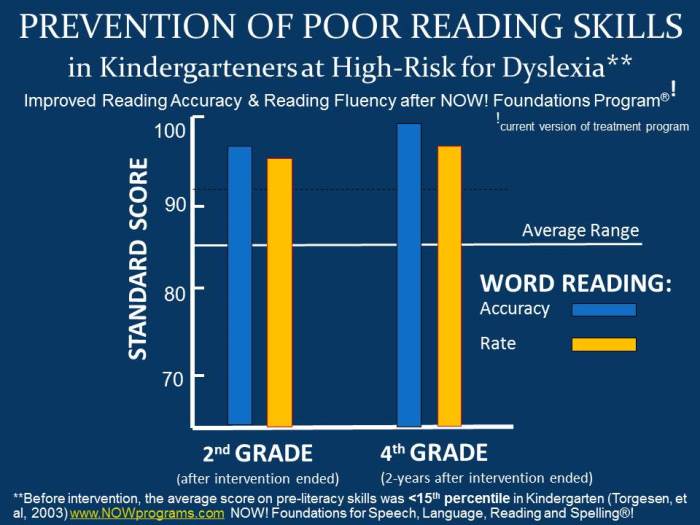
While it may sound too good to be true, the poor skills that cause you or your child to struggle can be remediated. Our evidence-based, online dyslexia tutoring program has been scientifically proven to improve reading accuracy and reading fluency with lasting results! Just look at the results of our research.
Students who completed the NOW! Foundations program in kindergarten showed reading accuracy and fluency above their grade level when tested in 2nd grade, and again in 4th grade, two years after intervention ended.

Schedule Sessions with a
Dyslexia Tutor Online
We offer several choices to make it easy for you to access our online dyslexia tutoring. For those who want 1:1 learning, individual sessions are available at $85 per session. Small group sessions for two students are just $50 per session, per student. Larger groups of 3 to 4 students are $30 per session, per student. These rates are comparable to or less than standard academic tutoring services that don’t even address learning disabilities. Your investment now for a few short months can enable a lifetime of more effective and efficient learning.
Dyslexia Tutoring FAQs: What Parents Are Asking
Straight answers to the questions families search for most when researching online reading intervention.
What causes struggling readers to need structured online reading intervention?
Most struggling readers have weak phonological processing, the ability to hear and work with the sounds inside words. It isn't about motivation or intelligence, and it doesn't resolve on its own. Structured, sequential instruction that targets these skills directly is what closes the gap.
What is NOW! Foundations for Speech, Language, Reading & Spelling®?
NOW! Foundations for Speech, Language, Reading & Spelling® is our core dyslexia program. It targets the phonological and language skills at the root of reading difficulty through daily sessions with a live instructor (one-on-one, pairs, or small group), following the structured sequence validated in NICHD-funded randomized controlled trials. Most students complete it before moving into our programs for comprehension, grammar and writing, or math.
What is phonological awareness, and why does it matter for reading?
It's the ability to hear and work with the individual sounds in spoken words, like knowing "cat" has three sounds, or that changing the first sound makes "hat." It's the strongest predictor of early reading success, and weakness in it sits at the core of most dyslexia. Without it, a learner can't reliably connect letters to sounds, which is why NOW! Programs® builds it first.
How does online instruction build phonological awareness and reading fluency?
Through live, multisensory sessions that engage sight, hearing, movement, and touch. Working with an instructor, the client:
- Hears, says, and manipulates the individual sounds in words.
- Links those sounds to letters for reading and spelling.
- Builds toward fluent, automatic word reading.
Repeated, structured practice strengthens the brain's reading pathways, a process called experience-dependent neuroplasticity. Because sessions are live and interactive, not videos or self-guided software, the online format doesn't dilute it.
My child's reading has improved but fluency still lags. Do you also address spelling?
Yes. Spelling is taught directly in NOW! Foundations for Speech, Language, Reading & Spelling®.
- Fluency is how quickly and smoothly your child reads.
- Spelling is encoding: turning sounds into letters, the reverse of reading.
Reading often improves up to a point, then slows again as words get longer and hidden decoding gaps resurface. Spelling trouble points to the same gaps. Fluency also takes time, like learning to ride a bike: once the skills are solid, speed follows. Your child's instructor targets the specific sound and pattern gaps behind both.
What makes an online reading program effective, and what research backs NOW! Programs®?
Look for independent, peer-reviewed research, which few online programs have. NOW! Foundations for Speech, Language, Reading & Spelling® is backed by three NICHD-funded randomized controlled trials: two journal articles (Torgesen et al., 1999 and 2001), documented on our Research and Evidence page, and a book chapter.
The gains also lasted. In the remediation trial, improvements held at a two-year follow-up, and 24 students exited special education services.
Can online intervention help students with severe dyslexia?
Yes. The remediation trial behind NOW! Foundations for Speech, Language, Reading & Spelling® specifically studied children with severe reading disabilities, a level many programs aren't tested for. Participants received intensive one-to-one instruction. For these learners, intensity matters most: daily sessions rather than weekly, which the online model makes easier to keep.
Do these programs work for teenagers and adults, or only young children?
Yes. NOW! Programs® serves learners ages 5 to 75, including teens, college students, and adults who never had effective early intervention. The brain's ability to build reading skills continues throughout life, and older learners often progress efficiently because they bring motivation and focus. Instruction is always matched to age and goals, so a teen or adult never works through material designed for a young child.
We're relocating. Can you coordinate with our current plan and keep us updated?
A move doesn't have to interrupt your child's program. Because instruction is online:
- Sessions continue anywhere with an internet connection.
- There's no waitlist and no new provider to find.
- Our intake team reviews any previous testing you share, so the work picks up where your child is now.
- You get regular progress updates, and the plan adjusts to your child's pace.
We live in a rural area with no local dyslexia specialist. How do I choose between session types, and how can I evaluate instructor credentials remotely?
Online instruction was built for this situation. It gives rural families access to specialists without the drive.
Choosing a session type:
- One-on-one (1:1) offers the instructor's full attention and the fastest pace. Best for significant gaps or a history of struggling despite help.
- Pairs (1:2) and small group (1:3-4) cost less per student and suit steady progress alongside peers.
- The further below grade level, the more one-on-one time pays off.
When evaluating credentials, ask:
- What specific training do the instructors have?
- Is instruction based on peer-reviewed research or a single proprietary method?
- Can the program point to measured outcomes?
NOW! Foundations for Speech, Language, Reading & Spelling® is grounded in NICHD-funded randomized controlled trials (Torgesen et al., 1999; 2001), and every NOW! Programs® instructor delivers the same structured method.
What a Week Looks Like
Sessions are one-on-one (1:1), pairs (1:2), or small group (1:3-4), depending on what fits the client best. Each session runs 45 to 50 minutes, scheduled at a regular time so the work becomes a dependable part of the week. Because instruction is live and led by an instructor in real time, every session adjusts to how the client is doing that day, rather than following a fixed script.
Our instructors move through the work as quickly as the client can go, and slow down wherever a skill needs to be fully solid before moving on. Speed is never the goal on its own. A skill that is only partly in place tends to resurface as a problem later, so instructors make sure each foundation is secure before building the next layer on top of it. This is why two clients starting at the same place can progress at different paces, and both are being taught correctly.
A path built around each client
NOW! Programs® is a set of programs designed to work in sequence, where each one builds on the skills developed before it. But not every client needs all four. Each client’s journey is individualized: after the initial consultation, instruction is matched to what the client actually needs, and the path is adjusted as the client progresses.
- NOW! Foundations for Speech, Language, Reading & Spelling® is the starting point for most clients, building the sound and language skills that reading and spelling depend on.
- NOW! Mental Imagery™ develops the ability to form mental pictures of what a client hears or reads, which drives comprehension, memory, and reasoning.
- NOW! Grammar & Writing™ extends those skills into written expression.
- NOW! Math Concept Imagery™ applies the same imagery-based approach to mathematical reasoning.
What sets this apart: many dyslexia interventions stop at decoding, getting a client to read the words accurately. NOW! Mental Imagery™ goes further, treating comprehension, the ability to understand and hold on to meaning, as a skill that can be directly taught. When a client struggles to visualize, much of their effort goes into sounding out words, leaving little capacity to understand and remember. Building this skill frees that capacity, so a client can improve reading and listening comprehension, retain more, and use written information on the first try rather than re-reading it several times.
Because these programs are delivered online using the same structured, standardized method, a client who does move from one program to the next continues without starting over. The individual instructor may change, but the program being delivered and the method behind it stay the same, so the quality and the approach do not depend on which instructor a client is matched with.
The time is NOW!
Conquer learning differences and acquire the skills needed for academic and career success. Sign up for a free consultation to get started.